Romania’s Electoral Crisis: The Constitutional Court Annuls the First Round of the 2024 Presidential Elections
9.12.2024Ioana Pascal
In a decision that will remain a landmark in Romania’s political history, the Constitutional Court of Romania (CCR) annulled the first round of the presidential elections held on November 24, 2024. This ruling, made on Friday, December 6, just two days before the second round of voting, sparked controversy and strong reactions from both the political sphere and society.
The decision was prompted by multiple allegations of foreign interference, electoral fraud, and irregularities that compromised the entire democratic process.
The ruling implies a complete restart of the electoral process, allowing new candidates to register.
Launch of the Electoral Campaign
The presidential campaign for the 2024 elections began traditionally, with Elena Lasconi, the pro-European candidate from the USR party, and other mainstream party candidates as favorites.
Călin Georgescu, an independent candidate with ultranationalist views, initially had modest support, focusing his message on addressing the cost-of-living crisis and advocating for “peace with everyone.”
However, by early November, Georgescu started gaining significant traction. His campaign relied almost exclusively on TikTok, where algorithms, coordinated accounts, and aggressive promotions brought him widespread attention. Within weeks, Georgescu became one of the leading candidates—a phenomenon that shocked political officials.
The First Round of Elections (November 24, 2024)
On November 24, Romanians cast their votes in the first round of the presidential elections. The results were surprising:
Călin Georgescu: 22.9% of the votes.
Elena Lasconi: 19.2%.
Georgescu emerged as the unexpected frontrunner, surpassing traditional candidates. His success raised serious concerns at both national and international levels, especially due to his rhetoric, perceived as favorable to Russia, and his opposition to Romania’s support for Ukraine.
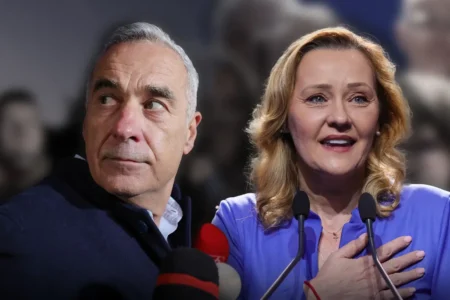
Calin Georgescu and Elena Lasconi. Photo: Inquam Photos
Revelations About Foreign Interference
Shortly after the first round of voting, the Supreme Council of National Defense (CSAT) declassified documents indicating Russia’s involvement in Călin Georgescu’s electoral campaign. The findings included:
– Over 85,000 cyberattacks on election-related websites.
– The creation of fake accounts and aggressive promotion on TikTok to influence voters.
– Use of resources “specific to a state actor” to support Georgescu’s candidacy.
These revelations garnered international attention, including from the U.S. Department of State, which warned that Romania’s deviation from Western values could impact strategic relations.
CCR’s Decision to Annul the Elections (December 6, 2024)
In light of these revelations and multiple complaints regarding irregularities in the electoral process, Romania’s Constitutional Court (CCR) announced the annulment of the first round of the presidential elections.
The court’s reasoning was based on several issues, all highlighting serious irregularities in the electoral process:
Electoral Disinformation: According to the CCR, voters did not have access to accurate information about the candidates, which affected the integrity of the vote.
Foreign Interference: CSAT reports revealed the involvement of a “state actor” in digitally influencing the campaign of independent candidate Călin Georgescu.
Violation of Free and Fair Elections: The CCR concluded that the electoral process was significantly flawed, undermining citizens’ fundamental rights.
The CCR invoked Article 146(f) of the Constitution, arguing that the elections must be redone to ensure the legality and fairness of the process.
This unprecedented decision was final, necessitating a complete reset of the electoral calendar.
Source: Constitutional Court of Romania (CCR)
Political Reactions
The CCR’s decision sparked a wave of reactions across the political spectrum:
– Elena Lasconi (USR): Criticized the decision as “a blatant attack on democracy” and accused the state of “trampling on the will of the people.”
– Călin Georgescu: Denounced the ruling, claiming it was “a blow against the sovereign people.”
– Marcel Ciolacu (PSD: Supported the annulment, stating it was the “only correct solution” given the CSAT revelations.
– George Simion (AUR): Urged his supporters to avoid street protests to prevent escalating tensions.
– Diana Șoșoacă: Accused Romanian and foreign intelligence services of orchestrating a “coup.”
What’s Next?
The CCR’s decision entails several concrete steps to restart the presidential elections:
Reorganizing the Elections:
– The government must set a new election date and announce an updated electoral calendar.
– Candidates must restart the signature-gathering process and re-register.
Annulment of the Second Round:
– Voting in the diaspora for the second round, which had already begun, was halted. Over 33,000 Romanians abroad had cast their votes before the decision.
Impact on the Political Scene:
– The ruling provides political parties with the opportunity to propose new candidates. One potential candidate mentioned is Nicușor Dan, the mayor of Bucharest, who could represent an alternative for center-right parties.
Democratic Implications
The CCR’s decision raises fundamental questions about Romania’s democratic future:
– Trust in the System: Voters may become skeptical of the state’s ability to organize free and fair elections.
– Social Polarization: The ruling deepens existing social and political divisions.
– Political Maturity: Parties must show political responsibility by proposing credible candidates and fostering a discourse based on national unity.
Conclusion
The rerun of the presidential elections represents an unprecedented challenge for Romania. While the CCR’s decision aims to restore legality and fairness, its impact on political stability and public trust in democracy will be felt in the long term. In this period of political uncertainty, it remains to be seen whether political leaders can turn this crisis into an opportunity to strengthen democratic values.
We use cookies to ensure that we give you the best experience on our website. If you continue to use this site we will assume that you are happy with it.