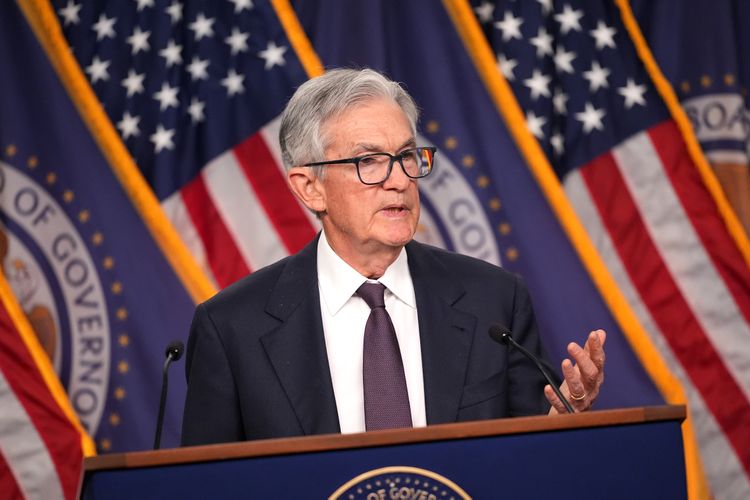
Fed Decision on Hold: How Long Will the Federal Reserve Delay Rate Cuts?
16.06.2025Ioana Pascal
All eyes are on the Fed this week, in a time of economic uncertainty and growing pressure from financial markets. As Federal Reserve officials prepare for the June monetary policy meeting, the signals are clear: an interest rate change is unlikely. But what really matters is what comes next—what guidance the Fed will offer regarding the future path of monetary policy for the remainder of 2025.
What Is Expected from the June FOMC Meeting?
The Fed is widely expected to keep the federal funds rate in the current range of 4.25% – 4.50%, as inflation continues to slow and the labor market remains strong. In theory, the central bank has the luxury of “waiting and watching,” but the reality is more complex.
With the newly imposed tariffs by the Trump administration and other unforeseen fiscal measures, the economic outlook for the rest of the year has become increasingly uncertain. The Fed now finds itself in a difficult position: current data looks strong, but storm clouds are gathering.
The Dot Plot May Matter More Than the Rate Decision
Perhaps the most anticipated part of the June FOMC meeting won’t be the rate decision itself, but the Fed’s updated economic projections—commonly referred to as the dot plot. These charts offer a detailed look at how each committee member sees interest rates evolving in the coming quarters.
Back in March, the Fed projected two rate cuts for 2025. Since then, inflation has remained “sticky,” new tariffs have been introduced, and the macroeconomic climate has grown more complex. Now, analysts expect the Fed to significantly revise downward its forecast for rate cuts. Some even expect only one cut in 2025.
Why Is the Fed Delaying Rate Cuts?
The Fed, led by Jerome Powell, is navigating a challenging environment where:
Inflation appears under control for now, but trade tariffs could quickly shift that outlook in the coming months.
The labor market remains stable, but warning signs are emerging in labor force participation and job creation.
Consumer and business sentiment is starting to decline amid political and trade uncertainty.
Fed Governor Adriana Kugler recently stated that she sees heightened inflation risks in the near term, along with potential downside risks to employment and output—justifying a cautious approach.
Markets Are Already Pricing in the Next Steps
According to the CME FedWatch Tool, bond traders now assign a 60% probability that the first rate cut will come in September, with 88% odds of at least two cuts before the end of the year.
However, forecasts vary:
Goldman Sachs expects just one cut in 2025.
JP Morgan believes the first cut will come in December.
Morningstar forecasts a first cut in July, followed by another at year-end.
Wells Fargo estimates a total of 0.75 percentage points in cuts over three phases.
UBS is the most optimistic, projecting a full 1 percentage point cut starting in September, conditional on labor market softening.
It’s Not Just About Tariffs
Although trade tariffs dominate the headlines, the Fed must also consider other variables that could shift the dynamics of the U.S. economy:
Changes in immigration policy.
New business regulations.
Major shifts in government spending.
Each of these factors could influence economic momentum and, in turn, monetary policy decisions.
Conclusion: What Comes Next?
Despite market pressure and short-term positive data, the Fed is in no rush. Officials appear determined to hold interest rates steady until the real impact of tariffs and new policies becomes visible.
Investors should closely watch:
The updated economic projections and the dot plot.
Jerome Powell’s comments during the press conference.
Reactions from the stock market, the U.S. dollar, and crypto markets.
2025 is shaping up to be a complex year, and every signal from the Fed is being dissected by analysts. What may seem like a simple delay in decision-making could, in fact, mark a profound recalibration of U.S. monetary policy.
We use cookies to ensure that we give you the best experience on our website. If you continue to use this site we will assume that you are happy with it.